Research writing13 min read
Thesis Writer’s Block: What to Do When You’ve Read Everything but Still Can’t Write
Stuck on your thesis or literature review after weeks of reading? Diagnose whether you are missing evidence, structure, or a starting point, then use practical steps to get words onto the page.
By The Carrel team
Writer’s block during a thesis is strange because it often appears after you have done a lot of work.
You have read the papers.
You have highlights.
You can explain the topic to your supervisor.
Your reference manager is full.
Then you open the chapter and cannot produce a paragraph you are willing to keep.
Graduate students describe this exact situation constantly. In one recent PhD thread, a researcher had been trying to rewrite an introduction for months: the themes were there, the reading was there, but the structure would not form. In another, a master’s student had already collected data and outlined themes, yet perfectionism and overlapping ideas made every sentence feel difficult to begin.
“Writer’s block” is a useful name for the experience, but it can hide several different problems.
Before you force yourself to write harder, work out what kind of stuck you are.
The first question: are you missing words, or are you missing a decision?
There is a big difference between:
I know what I want to say, but I cannot make the sentence sound right.
and:
I have no idea what this section is supposed to say.
The first is a drafting problem.
The second is usually a research or structure problem.
If you treat both as “I am bad at writing”, you will often respond in the wrong way.
You may spend an hour polishing a sentence when what you actually need is to compare two papers.
Or you may read ten more papers when you already have enough evidence and simply need permission to write a rough paragraph.
Use this diagnostic:
Can you say the point out loud?
Imagine your supervisor asks:
What is this section trying to establish?
Can you answer in two or three sentences?
If yes, write those sentences down exactly as you would say them. They do not need to sound academic yet.
If no, do not stare at the paragraph.
Go back one level and figure out the point.
Do not start with “write the chapter”
“Write Chapter 2” is not a workable task.
It is too large, too ambiguous, and too easy to avoid.
Turn it into something you can finish.
For example:
- Explain why the field disagrees about X.
- Compare the two dominant ways Y is measured.
- Write 300 words on evidence for mechanism Z.
- Group five papers that use the same method.
- Find the source behind this claim.
- Draft the paragraph that introduces Theme 2.
- Write three ugly topic sentences.
The smaller task should produce an object you can see at the end.
A paragraph. A table. A claim. A comparison. A revised heading.
Momentum is easier when the unit of work is smaller than “thesis”.
Ask what question the section is answering
A blank section heading can create its own writer’s block.
Compare:
Background
with:
Why have studies reached different conclusions about X?
The second heading gives the section a job.
Try turning each section into a question:
- What does the field agree on?
- What is the main theoretical dispute?
- Why do findings differ across studies?
- What evidence supports this mechanism?
- Which population is missing?
- How has the dominant method changed?
- What does the existing literature fail to explain?
You may change the headings later.
For now, a question is useful because your sources can respond to it.
The page is no longer asking you to “write something academic”.
It is asking you to answer something.
Separate evidence problems from structure problems
A common form of thesis writer’s block is the feeling:
I need to read more before I can write this.
Sometimes that is true.
Sometimes it is a very convincing way to avoid writing.
Test it.
You probably have an evidence problem if:
- an important claim depends on one weak source,
- you cannot find the study behind a statement you want to make,
- two papers disagree and you have not read enough to understand why,
- a key population, method, or theory is missing from your review,
- your supervisor has identified a concrete hole in the evidence.
You probably have a structure problem if:
- you have plenty of relevant sources but do not know what order to use them in,
- the same paper seems to belong in five places,
- your themes overlap heavily,
- every paragraph starts with an author’s name,
- you keep rewriting the outline without adding new evidence,
- you can explain individual papers but not what the group of papers establishes.
Evidence problems need research.
Structure problems need synthesis.
Do not solve one by doing more of the other.
Try the “three papers, one claim” restart
If the chapter feels too large, pick one claim you think is probably true.
Then choose three papers relevant to it.
For each paper, answer:
- What does this source let me say?
- How strong is that conclusion?
- Does it support, contradict, or qualify the claim?
- What conditions matter?
- Where is the evidence in the paper?
Now write one paragraph explaining the relationship between those three pieces of evidence.
Not the whole literature review.
One paragraph.
This is useful because writer’s block often shrinks when the task shifts from generating prose to explaining a relationship you can already see.
Start in the middle
You are not required to write a thesis in the order the reader will encounter it.
Purdue OWL explicitly recommends beginning in the middle when the opening is blocking you. Methods, results, a well-understood subsection, or even a rough explanatory paragraph may be easier starting points than the introduction.
The introduction often becomes easier after the rest of the document exists because you finally know what it is introducing.
The same is true inside a literature review.
If Section 2.1 is impossible but Section 2.4 is clear, write 2.4.
Your reader will never know which paragraph was born first.
Give yourself a bad first version on purpose
Perfectionism turns drafting into editing before there is anything to edit.
A first draft has a different job from a final draft.
Its job is to make your current thinking visible.
Try writing a deliberately plain version:
These studies disagree. A possible reason is that they measure the outcome differently. Studies using A tend to find X, while studies using B report Y. I need to check whether population differences could also explain this.
That is not finished academic prose.
It is extremely useful.
It tells you:
- the claim,
- the contrast,
- a possible explanation,
- the unresolved question.
You can improve the language later.
You cannot revise a paragraph that does not exist.
Leave markers instead of stopping
Long research writing becomes much easier when every missing detail does not trigger a new search session.
Use visible placeholders:
[CITATION][CHECK SAMPLE SIZE][FIND SOURCE FOR THIS CLAIM][DOES THIS CONFLICT WITH CHEN?][NEED TRANSITION][DEFINE TERM]
Then keep moving.
Purdue’s writer’s-block guidance makes the same point: if a small factual detail is interrupting the draft, leave yourself a note and verify it later rather than letting one check break the whole writing session.
There is an important exception.
If the missing information changes the argument itself, stop and verify it.
But if it is a local detail, mark it.
Drafting and verification can be separate passes.
If your themes overlap, that is information
Researchers often treat overlapping themes as evidence that the outline has failed.
Not necessarily.
It may mean the concepts are genuinely related.
Ask why the same evidence belongs in two sections.
Maybe:
- one theme is actually a mechanism inside the other,
- both themes are consequences of the same underlying variable,
- you have organised by topic when the literature is really organised by debate,
- the same study is relevant to two different claims,
- two planned sections should be merged,
- you need a hierarchy: theme → subtheme.
Try writing one sentence for the job of each section:
This section establishes ______.
If two sections produce almost the same sentence, merge or redefine them.
If the sentences are different, the overlap may be legitimate. The same paper can do different work in different parts of a thesis.
Stop using the literature review as a storage system
A literature review is not where every paper you read earns a place.
This is hard because removing a source can feel like wasting the time you spent reading it.
But the reader does not need a record of your reading effort.
They need the evidence necessary to understand your argument.
For every source in a section, ask:
What does this source do here?
Possible answers:
- establishes a finding,
- represents a major theory,
- provides conflicting evidence,
- explains a method,
- demonstrates a limitation,
- defines a concept,
- motivates the gap.
If the source has no job, it may not belong in that section.
The literature review becomes easier to write when you stop trying to reward every paper with a citation.
A 30-minute restart for a stuck writing day
When opening the thesis feels impossible, use this sequence.
Minutes 0–5: choose one question
Do not choose a chapter.
Choose a question the chapter needs to answer.
Minutes 5–10: gather the evidence
Pick three to five sources or notes that directly bear on the question.
Do not search for new papers yet.
Minutes 10–15: label the relationships
For each source, write:
- supports,
- contradicts,
- qualifies,
- extends,
- background.
Minutes 15–25: write the ugly paragraph
Explain what those relationships mean.
Do not edit sentences while drafting.
Minutes 25–30: leave the next move visible
End with one line:
Next: check whether the difference is explained by sample age.
or:
Next: find one longitudinal study that tests this mechanism.
Tomorrow you do not have to rediscover where to begin.
You left yourself a door back into the work.
Questions to ask when you get stuck midway
What am I trying to prove or explain in this paragraph?
If you cannot answer, the paragraph does not have a job yet.
Which sources actually belong to that claim?
Pull them together before you write.
Do they agree?
If yes, state the shared conclusion.
If they disagree, what is different?
Check method, population, definition, measure, theory, setting, and time period.
Am I missing evidence, or am I afraid the sentence will be bad?
Those require different responses.
Could I write this as bullet points first?
If yes, do that. Prose can come second.
Is the introduction the wrong place to start?
Often, yes.
What is the smallest piece I could finish today?
Finish that.
When reading has become avoidance
Research can feel productive even when it is no longer moving the writing forward.
A useful test is:
What specific sentence, paragraph, or decision will this next paper help me make?
If you cannot answer, pause before opening it.
You may still need the paper.
But make the purpose explicit.
Another good rule:
Search because the draft exposed a gap, not because the draft feels uncomfortable.
The discomfort of writing is not evidence that your literature is incomplete.
Sometimes it is just the discomfort of committing to a claim.
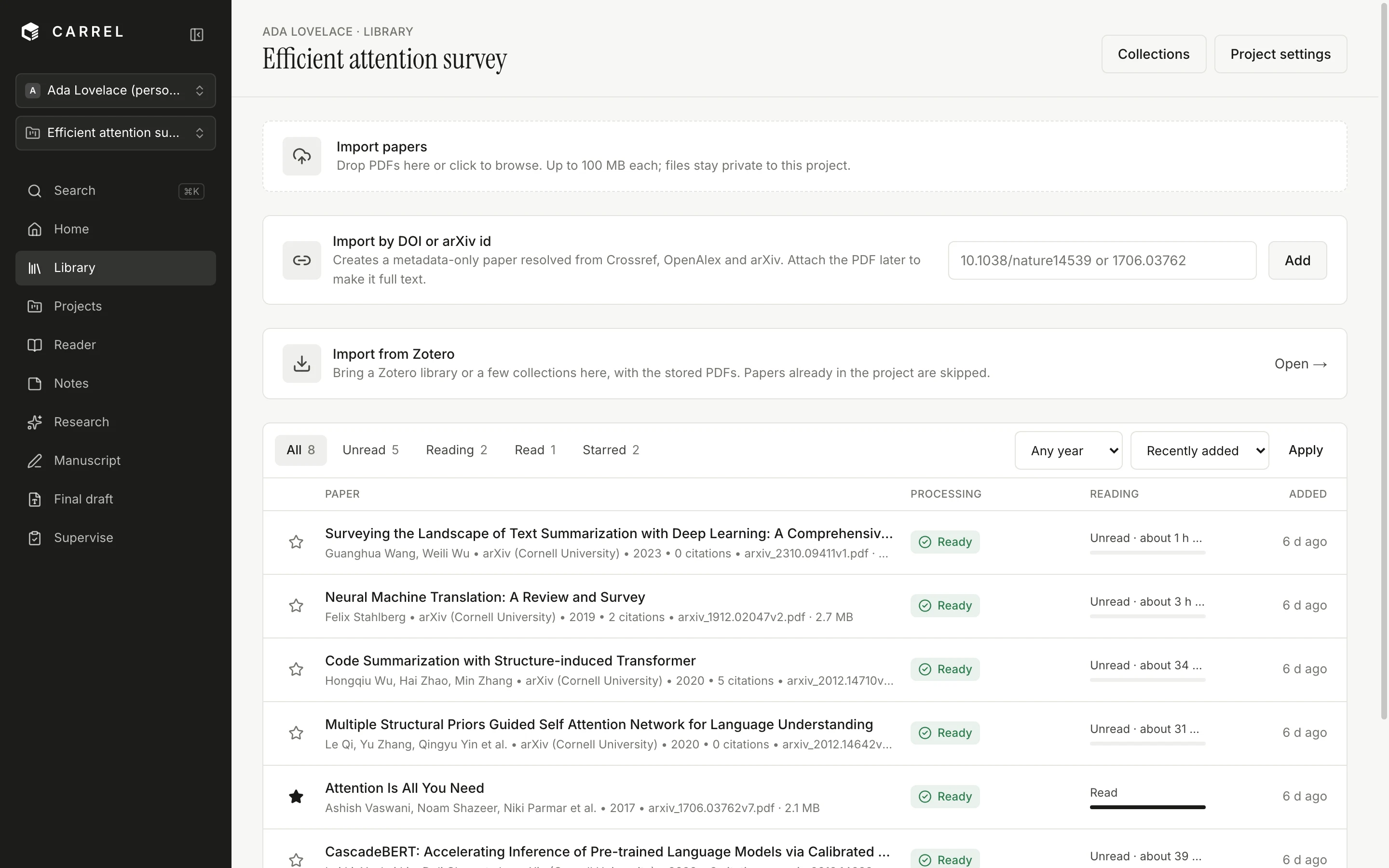
Where Carrel fits
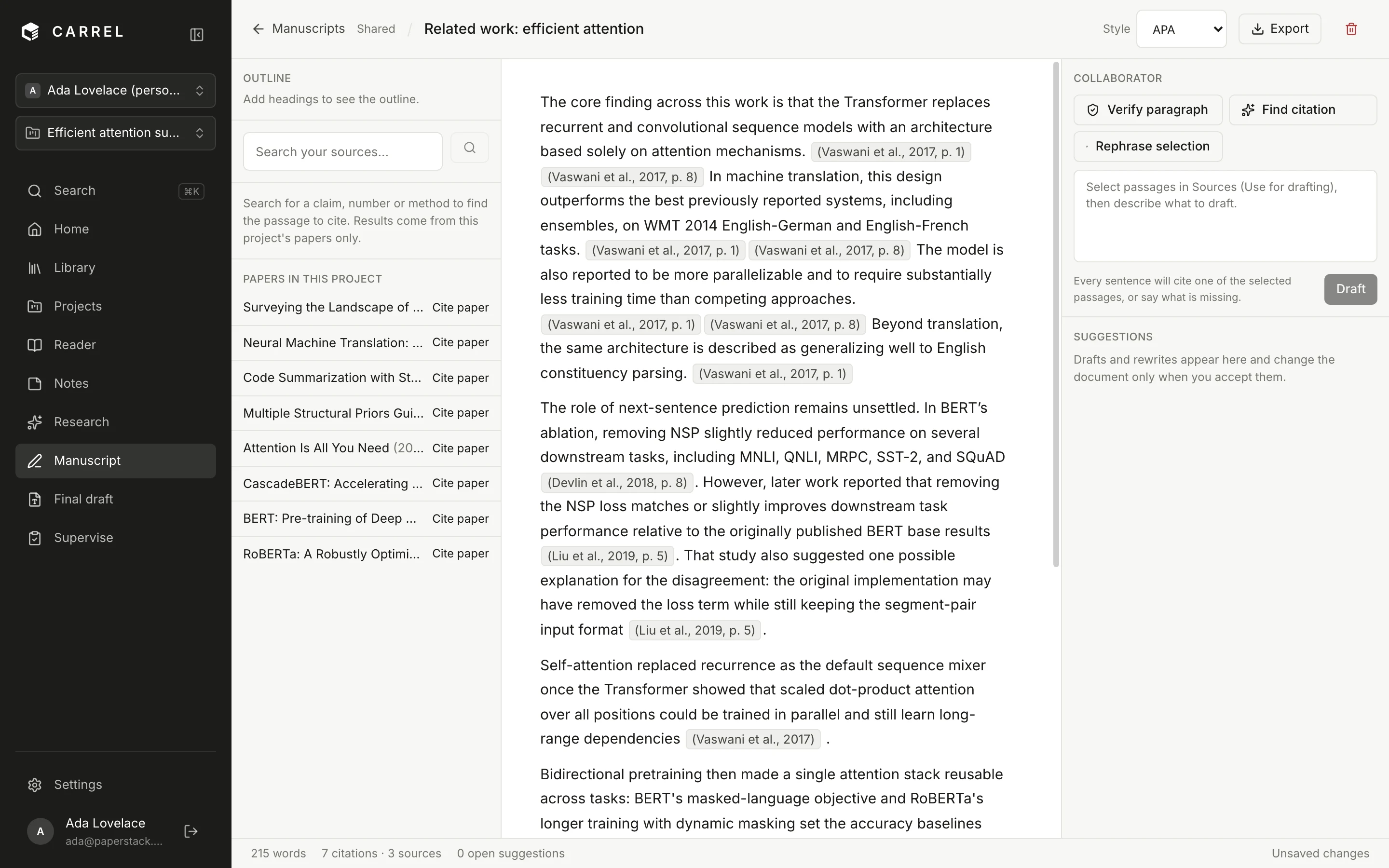
Carrel is built so that writing does not have to become a separate universe from the reading that produced it.
Your imported papers, highlights, notes, claims, methods, and findings can stay connected. When you are trying to understand a section, you can see which evidence supports a claim, which papers disagree, and where the source passage is.
Carrel can propose a starting structure from the evidence in your library and draft a section from the passages behind it, with citations attached.
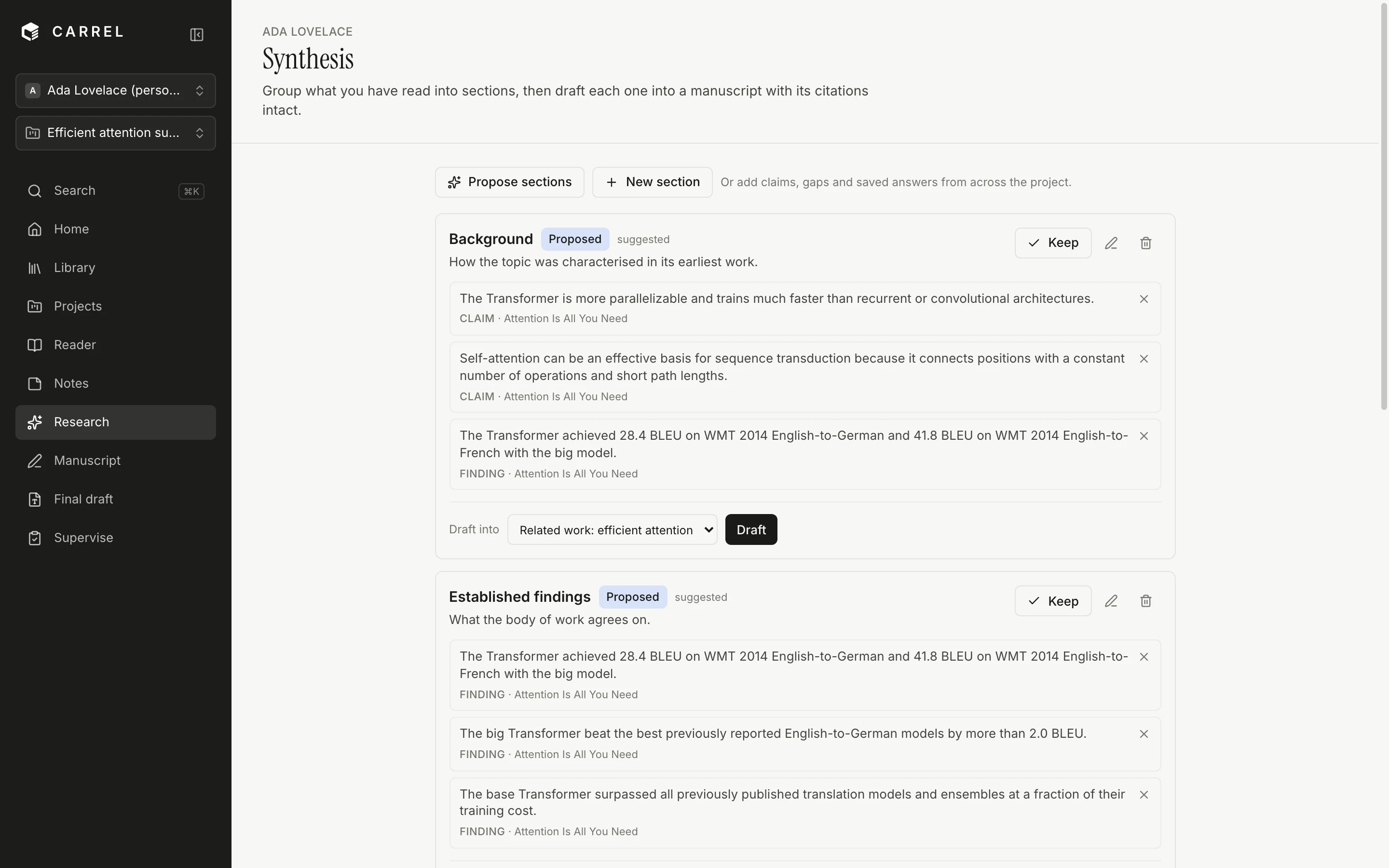
That draft is not the end of the researcher’s work.
It is a way past the empty page.
You still decide:
- whether the structure is right,
- which evidence matters,
- whether the interpretation is defensible,
- what the argument should be,
- what to delete,
- what needs another source,
- what you are actually willing to defend.
The useful part is that you can move backwards from prose to evidence.
If a sentence feels wrong, you can inspect the claim and open the passage behind the citation instead of searching through folders for the paper you vaguely remember.
How Carrel helps you write a thesis chapter from evidence you can trace →
You do not need to feel ready
Many thesis writers wait for a state of clarity that only arrives after they begin writing.
The outline does not have to be final.
The argument can change.
The first paragraph can be bad.
Your introduction can be written later.
Your job today is smaller:
Make one piece of the thinking visible.
Once it is visible, you can question it.
Once you can question it, you can improve it.
That is how the blank page becomes a draft.
What to read next
If your problem is that you still do not know what to read or where the review begins:
How to Start a Literature Review When You Don’t Know Where to Begin
If you have notes and papers but the draft keeps becoming one summary after another:
How to Synthesize a Literature Review Without Writing One Summary per Paper
Frequently asked questions
How do I overcome writer’s block on my thesis?
First identify what is blocking you. If you cannot explain the point of a section, work on the research question or structure. If you know the point but cannot phrase it, write a deliberately rough version and revise later. Break large tasks into small, concrete outputs such as one claim, one comparison, or one paragraph.
What part of a thesis should I write first?
You do not have to start with the introduction. Begin with the section for which the evidence and logic are clearest. Methods, results, or a well-defined literature-review subsection can be easier places to build momentum. Write the introduction later if necessary.
What if I keep reading instead of writing?
Ask what concrete gap the next paper will fill. If you cannot name the claim, question, or paragraph that needs the source, try drafting from the evidence you already have. Let the draft reveal where more research is actually needed.
How do I start a literature-review paragraph?
Start with the idea the paragraph needs to establish, not with an author’s name. State a working literature-level claim, bring in evidence from multiple relevant sources, explain how the sources relate, and end with the implication, limitation, or unresolved question.
Is it okay for a first thesis draft to be bad?
Yes. A first draft is working material. Its purpose is to expose your current argument and structure so they can be tested and revised. Accuracy still matters, but sentence-level polish can come later.
Sources and further reading
- Purdue OWL, Symptoms and Cures for Writer’s Block
- Purdue OWL, Thesis and Dissertation Resources
- UW–Madison Writing Center, Developing a Thesis Statement
- UW–Madison Writing Center, Creating a Reverse Outline
- r/PhD, How to write literature review without crying
- r/GradSchool, Having writer’s block when it comes to writing my thesis?
- r/GradSchool, Advice needed for writing thesis
The Reddit discussions above are used as qualitative examples of common researcher frustrations, not as representative survey data.
Written by The Carrel team. Published 24 September 2026.