Synthesis13 min read
How to Synthesize a Literature Review Without Writing One Summary per Paper
Learn how to synthesize a literature review by comparing claims, evidence, methods, agreements, contradictions, and gaps across papers instead of summarizing one source at a time.
By The Carrel team
There is a sentence supervisors write in the margin of literature reviews everywhere:
This is a list, not a review.
The frustrating part is that the draft may be factually correct.
Smith found X.
Chen found Y.
Patel found Z.
Every sentence has a citation. Every paper has been read. Nothing is obviously wrong.
But the paragraph still does not tell the reader what the literature means.
That is the difference between summary and synthesis.
A summary asks:
What does this paper say?
Synthesis asks:
What do these papers say together?
That change sounds small. In practice, it is the hardest part of writing many literature reviews.
It is also learnable.
What synthesis actually means
Synthesis is the process of putting sources into relation with one another.
You are looking for things like:
- agreement,
- disagreement,
- qualification,
- extension,
- recurring themes,
- differences in method,
- differences in population,
- changes over time,
- gaps in evidence,
- unresolved questions.
Purdue’s literature-review guidance uses a useful mental model: imagine your sources in conversation with one another. What would they agree about? What would they challenge? Which source changes how another should be interpreted?
Scribbr describes synthesis similarly: the task is to compare and contrast sources, show points of agreement and disagreement, and explain how they contribute to the broader research conversation.
The key word is relationship.
A synthesized paragraph is organised around an idea, not around a bibliography.
The easiest test: look at the subject of your sentences
Consider this paragraph:
Smith (2022) studied remote work and employee productivity. Smith found a small increase in self-reported productivity. Jones (2023) studied hybrid work and found no significant productivity effect. Lee (2024) studied fully remote software teams and reported higher output.
The subject keeps changing:
Smith. Jones. Lee.
That is usually a sign the paragraph is organised by paper.
Now reorganise the same evidence around a claim:
Evidence on remote work and productivity is mixed. Some studies report modest gains, particularly in fully remote knowledge-work settings, while others find little measurable effect. The difference may partly reflect how productivity is defined: self-reported productivity and recorded output do not necessarily capture the same outcome.
Now the subject is the evidence.
The papers support the paragraph rather than determine its structure.
That is synthesis.
Start with a claim, not an author
When you sit down to write a section, do not begin by asking:
Which paper should I write about first?
Ask:
What does the reader need to understand at this point?
That may produce a working claim such as:
- Most studies agree that X occurs under Y conditions.
- Evidence for X is mixed.
- Two methodological traditions produce different estimates.
- Research has concentrated on population A while population B is understudied.
- The field agrees on the effect but disagrees on the mechanism.
- A widely used measure may explain part of the disagreement.
None of these claims has to be final.
They are containers for evidence.
Once you have the claim, ask which papers belong inside it.
Build a synthesis matrix around ideas
A synthesis matrix is one of the simplest tools for moving from paper-by-paper notes to a literature-level view.
The traditional form is a table:
| Source | Theme A | Theme B | Method | Limitation |
|---|---|---|---|---|
| Paper 1 | Evidence | Evidence | Method | Limitation |
| Paper 2 | Evidence | — | Method | Limitation |
| Paper 3 | Contradicts Paper 1 | Evidence | Method | Limitation |
But there is another way to think about it that is often more useful for writing.
Put claims or questions at the centre:
| Claim / question | Supporting evidence | Conflicting evidence | Conditions | Sources |
|---|---|---|---|---|
| X improves Y | Papers 1, 2 | Paper 3 | Only in population A | 1, 2, 3 |
| Effect depends on Z | Papers 3, 4 | — | Longitudinal studies | 3, 4 |
This second version is closer to the structure of the prose you eventually need to write.
A recent r/research discussion made a similar recommendation: do not organise only by paper; organise by variable, theme, or claim so that disagreements and gaps become easier to see.
Use five questions to synthesize any group of papers
When you have several papers that seem related, ask these five questions.
1. What do they agree on?
Look for findings or assumptions that recur across independent studies.
Do not simply count papers. Consider:
- sample quality,
- study design,
- size,
- measurement,
- context,
- whether the studies are actually testing the same thing.
The point is not “three papers beat two”.
The point is to understand the shape and strength of the evidence.
2. Where do they disagree?
A disagreement is not an inconvenience to smooth over.
It is often the most interesting part of the literature.
Ask whether the papers genuinely contradict each other or whether they are answering slightly different questions.
Two papers may appear to disagree because:
- they use different definitions,
- they study different populations,
- one is cross-sectional and one longitudinal,
- their measures are different,
- the effect depends on context,
- one reports correlation and another estimates causation,
- the later paper includes evidence the earlier paper did not have.
A literature review becomes useful when it helps the reader understand those differences.
3. What explains the difference?
This is where synthesis becomes analysis.
Imagine three papers:
- Paper A finds a strong effect.
- Paper B finds a weak effect.
- Paper C finds no effect.
A weak review reports those findings in order.
A stronger review asks:
What changed between A, B, and C?
Perhaps A uses self-reported outcomes, while C uses behavioural data.
Perhaps the populations differ.
Perhaps the effect appears only above a certain threshold.
Perhaps the studies use the same word for different constructs.
Now you have the beginning of an argument.
4. What has not been tested?
A gap is not simply “I could not find a paper about this”.
Useful gaps emerge from the structure of existing evidence.
For example:
- a relationship is well studied in adults but not adolescents,
- an effect is established in laboratory settings but uncertain in the field,
- a theory predicts a mechanism that has not been measured directly,
- findings conflict and no study has tested the likely moderator,
- a method dominates the literature and may hide a different result.
Be cautious with gap claims. “Nobody has studied X” is difficult to defend.
It is usually safer and more useful to state exactly what appears underexamined in the literature you have reviewed.
5. Why does this matter for your research question?
A literature review is not an encyclopaedia.
The reader needs to understand why this body of evidence leads to the problem your study addresses.
After every major theme, ask:
So what?
What does this evidence establish?
What does it fail to establish?
What decision does that create for your research?
That is the bridge from review to contribution.
A paragraph model you can actually use
You do not need a rigid formula for every paragraph, but this sequence is a useful starting point.
1. Make the literature-level claim
Studies generally associate X with Y, but the effect is inconsistent across measurement approaches.
2. Bring several sources into the same sentence or passage
Survey-based studies report a stronger association, while longitudinal and behavioural measures tend to produce smaller estimates.
3. Explain the relationship
This suggests that part of the disagreement may reflect how the outcome is measured rather than a simple absence or presence of the effect.
4. Add the limitation or unresolved point
However, relatively few studies apply both measurement approaches to the same population, making the methodological explanation difficult to isolate.
5. Connect it to your research
Comparing both measures within one cohort therefore provides a way to test whether the apparent inconsistency is methodological.
Notice what this structure does not do.
It does not give each author a turn.
It gives each idea a job.
Words that reveal relationships
Academic synthesis often depends on a small set of relational moves.
Agreement
- similarly
- consistent with
- also finds
- converges with
- supports
Contrast
- however
- in contrast
- whereas
- by comparison
- unlike
Qualification
- although
- under these conditions
- primarily among
- except when
- this effect weakens when
Extension
- builds on
- extends
- applies this finding to
- tests the same mechanism in
- adds evidence from
Interpretation
- this suggests
- taken together
- one explanation is
- the difference may reflect
- collectively, these findings indicate
The words themselves do not create synthesis.
But if you cannot identify the relationship that belongs between two sources, you may not yet know why they are in the same paragraph.
Do not manufacture agreement
There is a temptation when writing literature reviews to make the field look cleaner than it is.
Do not.
If the evidence is inconsistent, say it is inconsistent.
If only one study supports a claim, do not write as though a consensus exists.
If two papers use incompatible measures, do not flatten their results into the same category just because they share a keyword.
Good synthesis preserves uncertainty.
The goal is not to make the literature tell a simple story.
The goal is to make the structure of the literature visible.
A useful exercise: three papers, one paragraph
Pick three papers that belong to the same theme.
For each paper, write one sentence answering:
What is the strongest relevant claim I can make from this paper?
Then put the three claims next to one another.
Ask:
- Which two are closest?
- Does the third support, contradict, or qualify them?
- Is the disagreement about the finding, the method, the population, or the definition?
- What sentence could describe all three at once?
- What does the reader learn from seeing them together?
Now write the paragraph around that answer.
This is a much better synthesis exercise than trying to make three summaries sound smoother.
Questions to ask midway through a literature review
If the draft is becoming a catalogue, stop and ask:
Does every section have a question?
A heading like “Previous research” invites summary.
A heading like “Why do estimates of X differ?” invites synthesis.
Can I name the main claim of each paragraph in five to ten words?
If not, the paragraph may be carrying too many unrelated sources.
Are multiple sources doing work in the same paragraph?
One citation per paragraph is not automatically wrong, but a literature review made almost entirely of single-source paragraphs is worth inspecting.
Have I explained contradictions or only reported them?
“Studies disagree” is the start of analysis, not the end.
Are my gaps supported by the review I just presented?
The gap should emerge from the evidence. It should not arrive as a surprise in the final paragraph.
Could I remove the authors’ names and still explain the argument?
If the whole structure collapses without “Smith says / Jones says”, you are probably still organised around papers rather than ideas.
Where Carrel fits
Carrel was built around this exact problem.
A paper is useful, but the unit you often need while writing is smaller: a claim, finding, method, limitation, or passage.
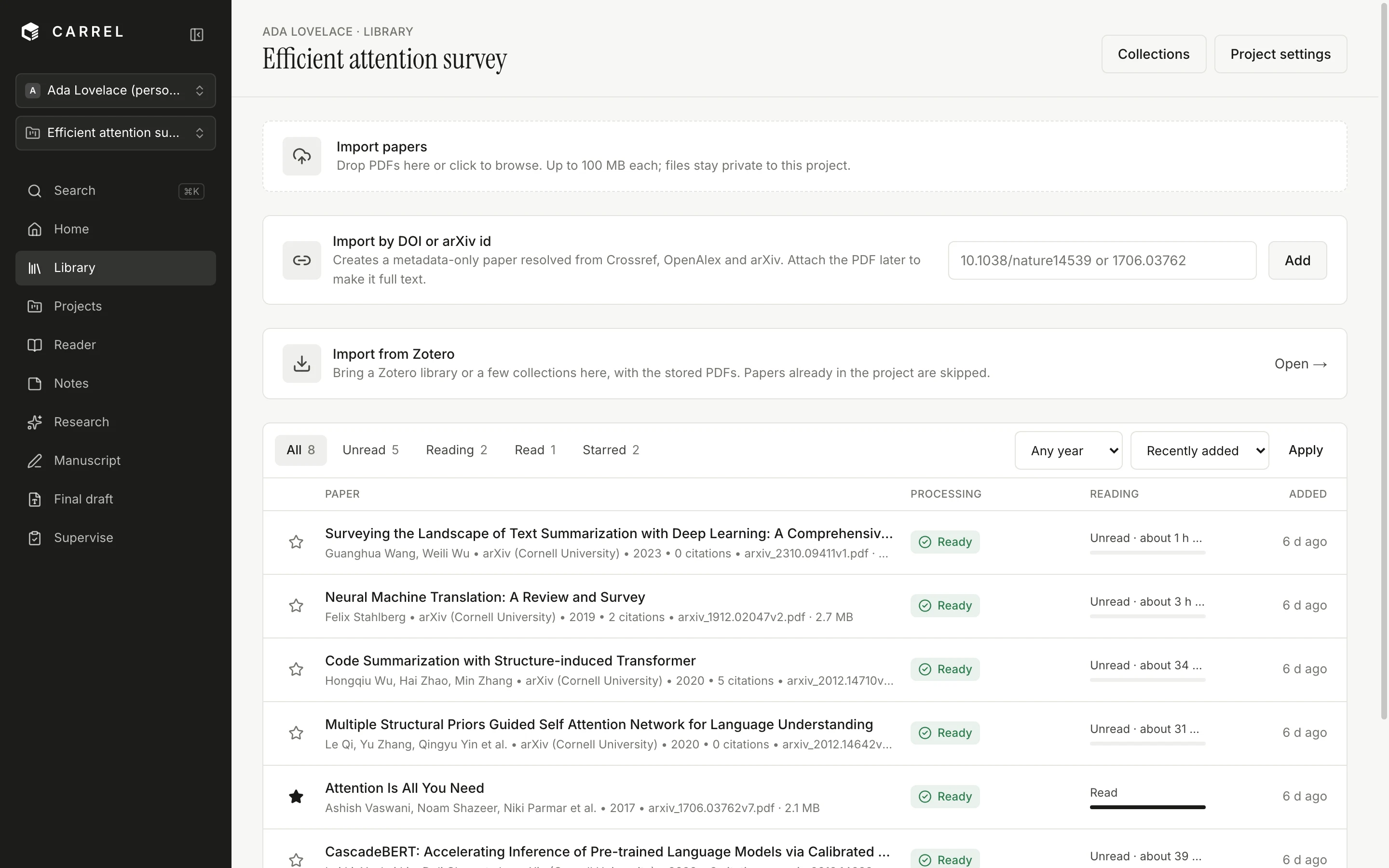
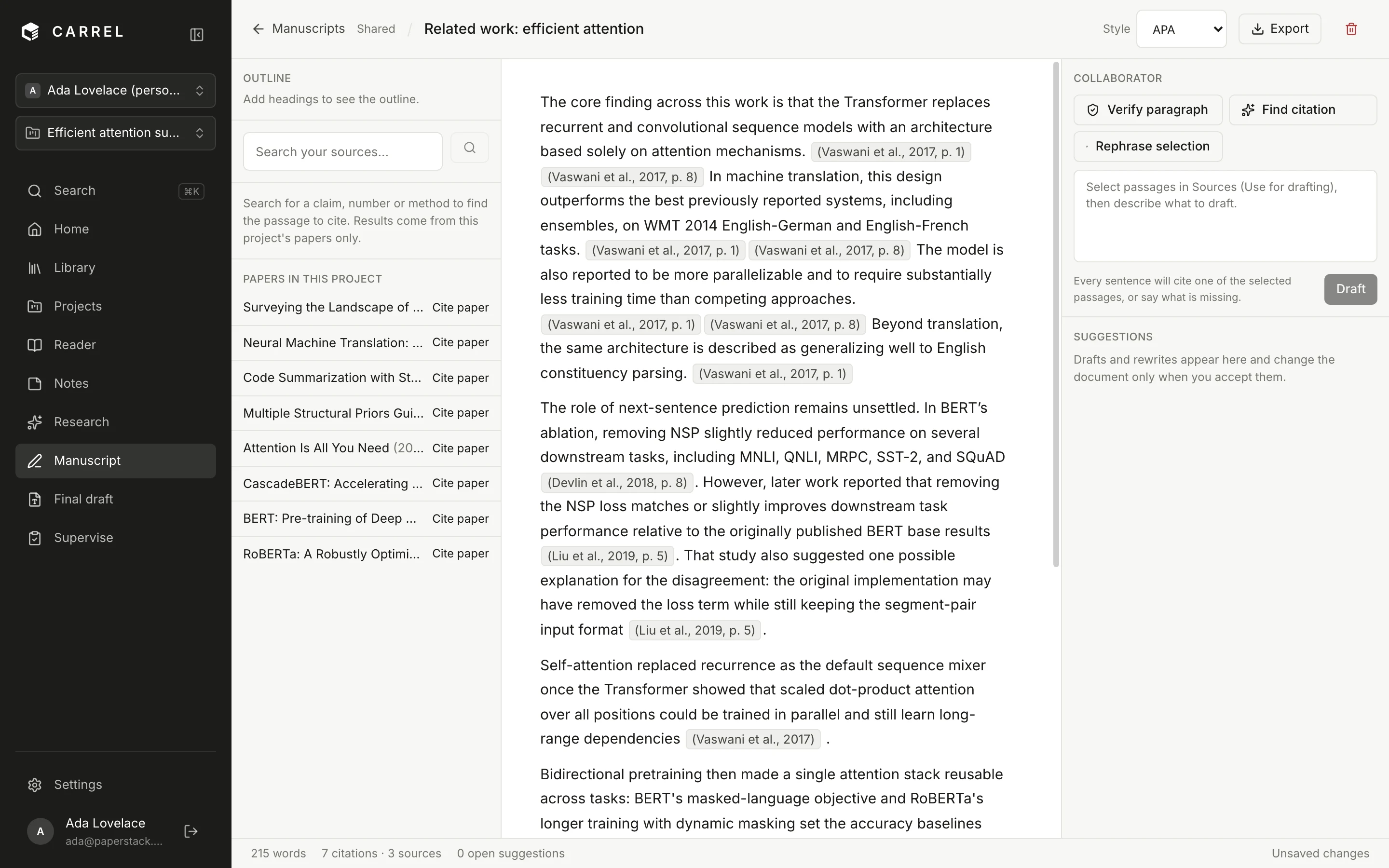
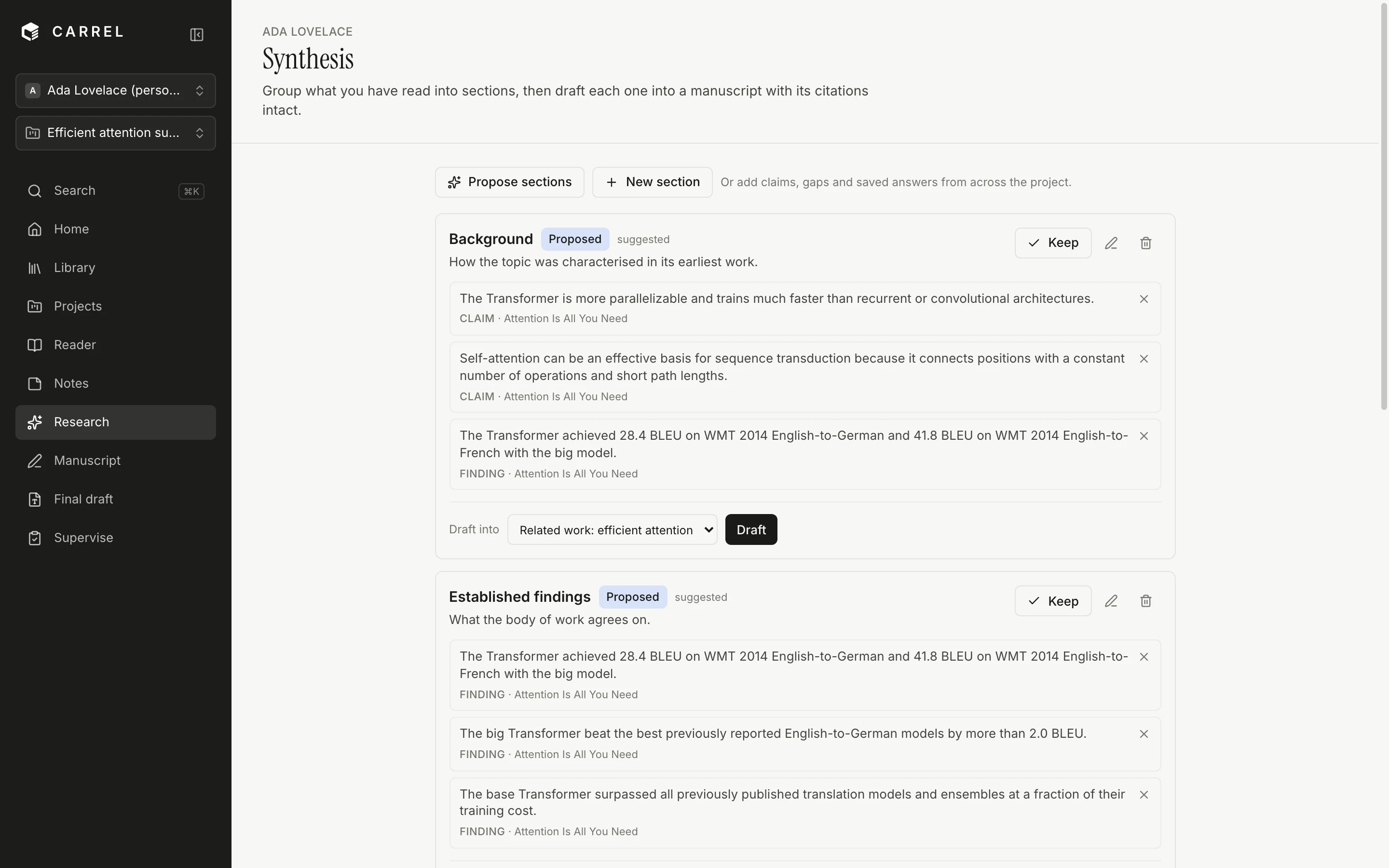
When papers are imported into Carrel, claims, methods, and findings can be extracted with the underlying passages attached. Carrel can then surface relationships between them — where one result supports another, where findings conflict, and where an answer remains unresolved.
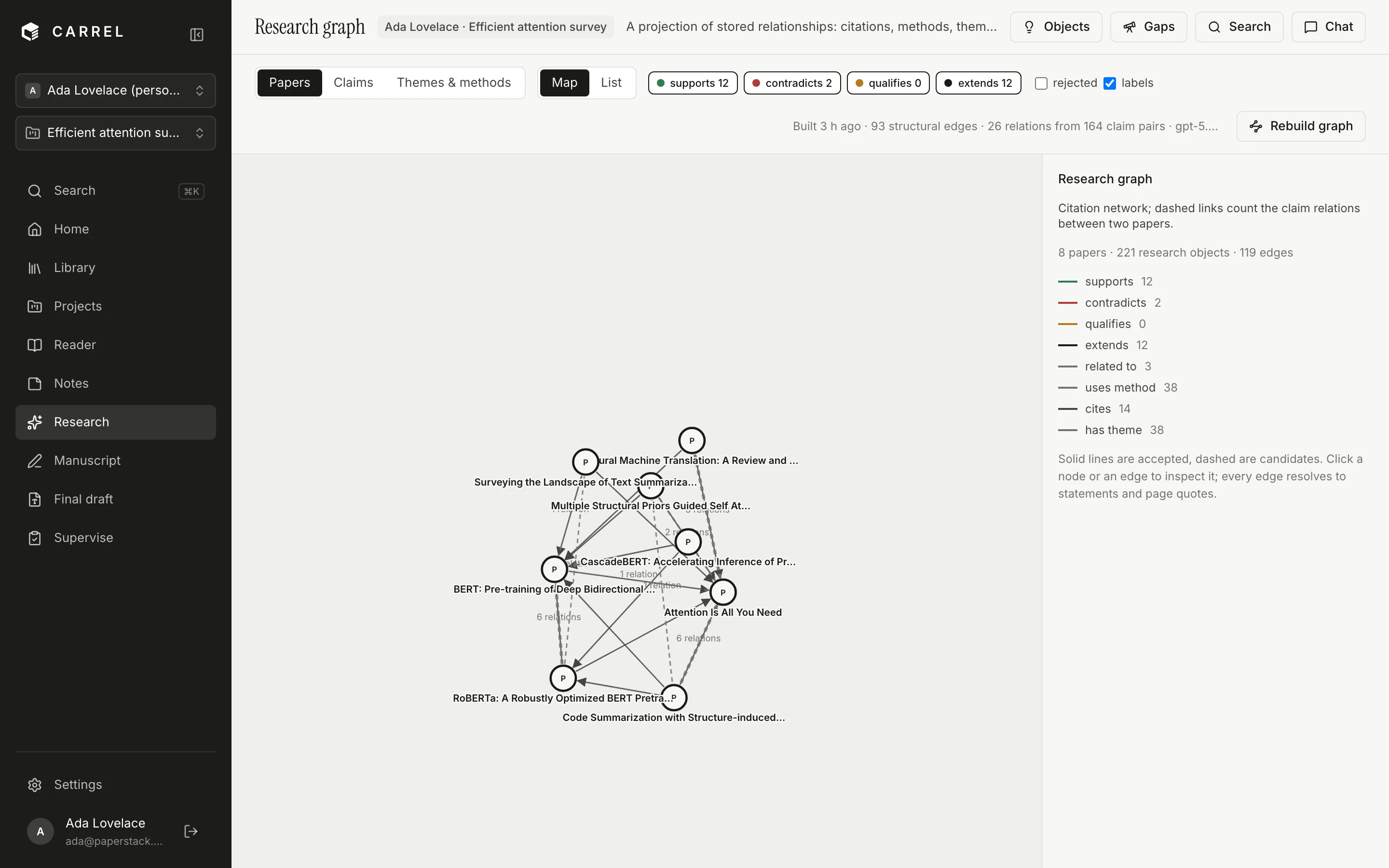
Those relationships can feed into proposed synthesis sections.
The important part is not that there is a graph.
It is that you can move from:
Paper A says this. Paper B says that.
to:
Here is the claim. Here is the evidence for it. Here is the evidence against it. Here is the condition that may explain the difference.
And when you begin drafting, the citations remain linked to the passages behind them so that you can check whether the prose still matches the evidence.
Carrel does not decide which interpretation is intellectually important.
That is your work.
It reduces the amount of remembering, refetching, and cross-referencing required to do that work.
How Carrel handles research synthesis: claims, evidence and the relations between them →
What to do next
If you are still collecting papers and do not yet have a working structure, start here:
How to Start a Literature Review When You Don’t Know Where to Begin
If you understand the themes but still cannot get words onto the page:
Thesis Writer’s Block: What to Do When You’ve Read Everything but Still Can’t Write
Frequently asked questions
What does it mean to synthesize a literature review?
Synthesis means combining and comparing evidence from multiple sources to explain what the literature shows as a whole. Instead of describing papers one by one, you organise the review around themes, claims, debates, methods, or questions and show how sources relate to one another.
What is the difference between summary and synthesis?
Summary explains what an individual source says. Synthesis explains the relationship between multiple sources. A literature review needs both, but synthesis is what turns separate paper summaries into an account of the field.
What is a synthesis matrix?
A synthesis matrix is a table used to compare sources across recurring themes, questions, methods, or claims. It helps you read across papers rather than keeping each source in an isolated set of notes.
How do I identify a research gap?
Look for unresolved contradictions, neglected populations or contexts, untested mechanisms, methodological limitations, or questions that existing evidence does not settle. Treat gap identification as a conclusion drawn from the literature rather than as a search for a topic no one has ever mentioned.
Can AI synthesize research papers for me?
AI can help organise and compare material, but synthesis still requires scholarly judgement. You need to decide which sources are credible and relevant, whether findings are genuinely comparable, what a disagreement means, and which interpretation matters for your research. Keep AI-assisted claims traceable to the source material so you can verify them.
Sources and further reading
- Purdue OWL, Writing a Literature Review
- Scribbr, Synthesizing Sources
- Scribbr, How to Write a Literature Review
- Harvard Library, Literature Reviews
- r/GradSchool, Literature Reviews
- r/research, Literature review — best way to write and synthesize?
- r/PhDStress, How to Build a Coherent Literature Review
The Reddit discussions above are used as qualitative examples of common researcher frustrations, not as representative survey data.
Written by The Carrel team. Published 24 September 2026.