Research writing13 min read
How to Start a Literature Review When You Don’t Know Where to Begin
Not sure how to start your thesis literature review? Learn how to narrow your question, choose your first papers, take useful notes, find themes, and begin writing without waiting to read everything.
By The Carrel team
You open your thesis folder.
There are papers in Zotero, PDFs in Downloads, tabs you have kept open because they looked important, and a document called Literature Review.docx.
The document is mostly blank.
This is a very normal place to get stuck. The problem is rarely that there is no literature to find. It is usually the opposite: there is too much of it, and nobody has given you a clean rule for deciding what to read, what to keep, or what to write first.
A recent PhD discussion on Reddit put the problem plainly: the student already had a rough skeleton and was reading paper after paper, but still felt completely stuck on where to begin. Other graduate researchers describe the same pattern in different forms — dozens of tabs, growing folders, endless highlighting, and no obvious transition from reading to writing.
The way out is not to read everything.
It is to give the reading a job.
This guide gives you a practical way to do that.
Start with a question, not with a pile of papers
A broad topic tells you where to search. A question tells you what to do with what you find.
Suppose your topic is:
Social media and adolescent mental health.
That is useful as a field of interest, but it is not yet useful as a reading instruction.
Turn it into questions you can ask of the literature:
- What outcomes have researchers measured?
- Which effects are reported most consistently?
- Where are the findings mixed?
- Which populations have been studied?
- What mechanisms are proposed?
- Which methods produce different conclusions?
- What remains uncertain?
Now every paper has a reason to be there.
Instead of asking, “Is this paper about my topic?”, you can ask:
Which of my questions does this paper help answer?
That small change matters. It is the difference between collecting literature and beginning a review.
Your first task
Write one main research question and three to five supporting questions.
They do not need to be final. A working question is allowed to change as you learn more. In fact, good research questions often do.
The purpose of the question at this stage is not to lock your thesis in place. It is to stop every interesting paper from looking equally important.
Define a working boundary before you search
A literature review can expand forever if you never decide what is outside it.
Before you begin serious reading, write down a temporary boundary for your review.
For example:
- Population: adolescents aged 12–18
- Topic: social media use and mental-health outcomes
- Study types: empirical peer-reviewed research
- Time period: 2015 onward, plus major earlier studies
- Language: English
- Geography: any, but note country differences
- Exclusions: studies focused only on marketing or platform design
Your boundary will probably change. That is fine.
The point is to make an initial decision about relevance so that “maybe useful later” does not become the category every paper falls into.
Harvard Library notes that literature searching often creates a problem of overabundance rather than scarcity. That is exactly why a boundary is useful: it gives you a defensible reason to stop following every citation trail.
Build a seed set, not the perfect library
You do not need 100 papers before you can begin.
Start with a small set that helps you understand the shape of the conversation.
A useful seed set often includes:
- one or two recent review papers,
- a few highly cited or foundational papers,
- several recent empirical papers close to your exact question,
- papers recommended by your supervisor,
- papers that take noticeably different positions.
Then use those papers to expand deliberately.
Look backward through their references. Look forward at newer papers that cite them. Notice which authors, theories, measures, and debates keep appearing.
Your goal is not to assemble the final bibliography in one sitting.
Your goal is to learn enough of the field that you can make better decisions about what to read next.
Do not read every paper from page one to the references
There is a difference between deciding whether a paper matters and reading a paper closely.
For an initial pass, try to answer:
- What question is this paper asking?
- What did the authors do?
- What did they find?
- Why might this matter to my research question?
- Do I need to read this closely?
The title and abstract can often tell you whether the paper belongs in your working set. The introduction and conclusion can help you understand its argument and context. But if the paper becomes important to a claim you intend to make, go into the methods, results, limitations, and relevant passages rather than relying on the abstract alone.
That distinction matters because a literature review is not built from abstracts. You eventually need enough contact with the evidence to understand why papers agree, why they disagree, and how strong their conclusions actually are.
A recent discussion in r/research made this point well: reading only abstracts and conclusions may be enough for scoping, but it can leave you with a stack of summaries instead of the material needed for real synthesis.
Take notes that answer your questions
One of the easiest ways to create extra work for yourself is to make notes that are organised only by paper.
You end up with something like:
Smith et al. (2024)
- Used survey data
- Sample of 1,200 students
- Found association between X and Y
- Limitation: self-reported use
Chen et al. (2025)
- Longitudinal study
- Sample of 800
- Found weaker association
- Controlled for Z
Those notes are not useless. But when you start writing, you still have to remember that Smith and Chen belong in the same paragraph.
Try adding another layer while you read.
For each useful finding, record:
- Question: What question of mine does this answer?
- Claim: What can I reasonably say based on this?
- Evidence: What did the paper actually find?
- Conditions: In what population, setting, or method?
- Relationship: Does it support, complicate, or contradict something I have already read?
- Source: Where exactly in the paper is the evidence?
Now the notes begin to look like the raw material of a literature review.
You are no longer only storing papers.
You are storing relationships between evidence.
Write before you feel finished reading
This is one of the most important habits in a long research project.
Do not make “finish the reading” a prerequisite for “start writing”.
There may never be a clean moment when the reading is finished.
Instead, write small pieces as soon as you can see a pattern.
You might write:
Most studies in this set report an association between X and Y, although the strength of the relationship varies by measurement method.
That sentence is not your final literature review.
It is a working claim.
Now ask:
- Which papers support it?
- Which paper complicates it?
- Is “most studies” actually true?
- Does the pattern hold across populations?
- What would make the sentence more precise?
Writing exposes what you understand and what you only think you understand.
That makes it part of the research process, not something that begins after the research process is complete.
Purdue’s writing guidance makes a similar point about drafting: a first draft is not a final draft, and you do not have to begin with the introduction. You can start where the material is clearest and return to the opening later.
Look for themes before you have “enough” papers
Students often wait too long to organise the literature.
They read 30, 50, or 100 papers and only then ask: what are my themes?
Do it earlier.
After your first meaningful set of papers, make a rough list:
- claims that keep appearing,
- theories that recur,
- common methods,
- disagreements,
- different populations,
- variables researchers treat differently,
- unanswered questions.
These are not necessarily your final section headings.
They are hypotheses about the structure of the literature.
You are allowed to change them.
A theme that initially looks important may disappear. Two themes may turn out to be one. A disagreement may become more interesting than the topic you originally thought would define the chapter.
The outline should follow your understanding, not trap it.
A simple working structure for your first literature review outline
If you genuinely do not know how to structure the document yet, begin with this:
1. What problem is this literature trying to understand?
Give the reader the context and define the scope of the review.
2. What does the field broadly agree on?
Group the strongest recurring findings or assumptions.
3. Where does the literature divide?
Show conflicting findings, theoretical disagreements, methodological differences, or boundary conditions.
4. Why might those differences exist?
Compare populations, methods, definitions, measures, datasets, or theoretical assumptions.
5. What remains unresolved?
Identify the question that the existing literature does not settle.
6. How does your research enter that conversation?
Connect the unresolved issue to your research question, method, context, or contribution.
This structure will not fit every discipline. Some reviews are chronological, methodological, theoretical, or organised around competing schools of thought.
But it gives you something better than a blank page: a set of questions your sources can answer.
Questions to ask yourself midway through the review
Literature reviews become difficult when reading turns into momentum without direction.
Every so often, stop and ask:
Can I explain the main debate without naming individual papers?
If not, you may still be thinking paper by paper.
Do I know which claims have strong support and which depend on one study?
This tells you whether you are building an argument from a body of evidence or leaning too heavily on isolated sources.
Which papers disagree, and do I know why?
A disagreement is more useful when you can explain its conditions.
Am I keeping a paper because it is relevant, or because I spent time reading it?
Time invested is not a reason to cite something.
Has my research question changed?
If your reading has changed your understanding of the problem, update the question. Do not keep forcing new evidence into an old frame.
What would I need to know before I could write the next section?
That question turns vague anxiety into a concrete research task.
How to know when to stop searching
There is no universal number of sources that means a literature review is complete. Requirements vary by field, document type, question, and degree level.
A better stopping test is informational.
You may be close to a workable set when:
- new searches mostly return papers you have already encountered,
- the same major authors and studies keep recurring,
- your core themes are supported by several sources,
- important disagreements are represented,
- you can explain why key papers are included,
- additional papers are refining the picture rather than changing it completely.
That does not mean you will never search again.
It means you have enough structure to write.
And once you start writing, the draft will tell you where the real gaps in your reading are.
Where Carrel fits
Carrel is designed around this transition from a body of papers to a piece of writing.
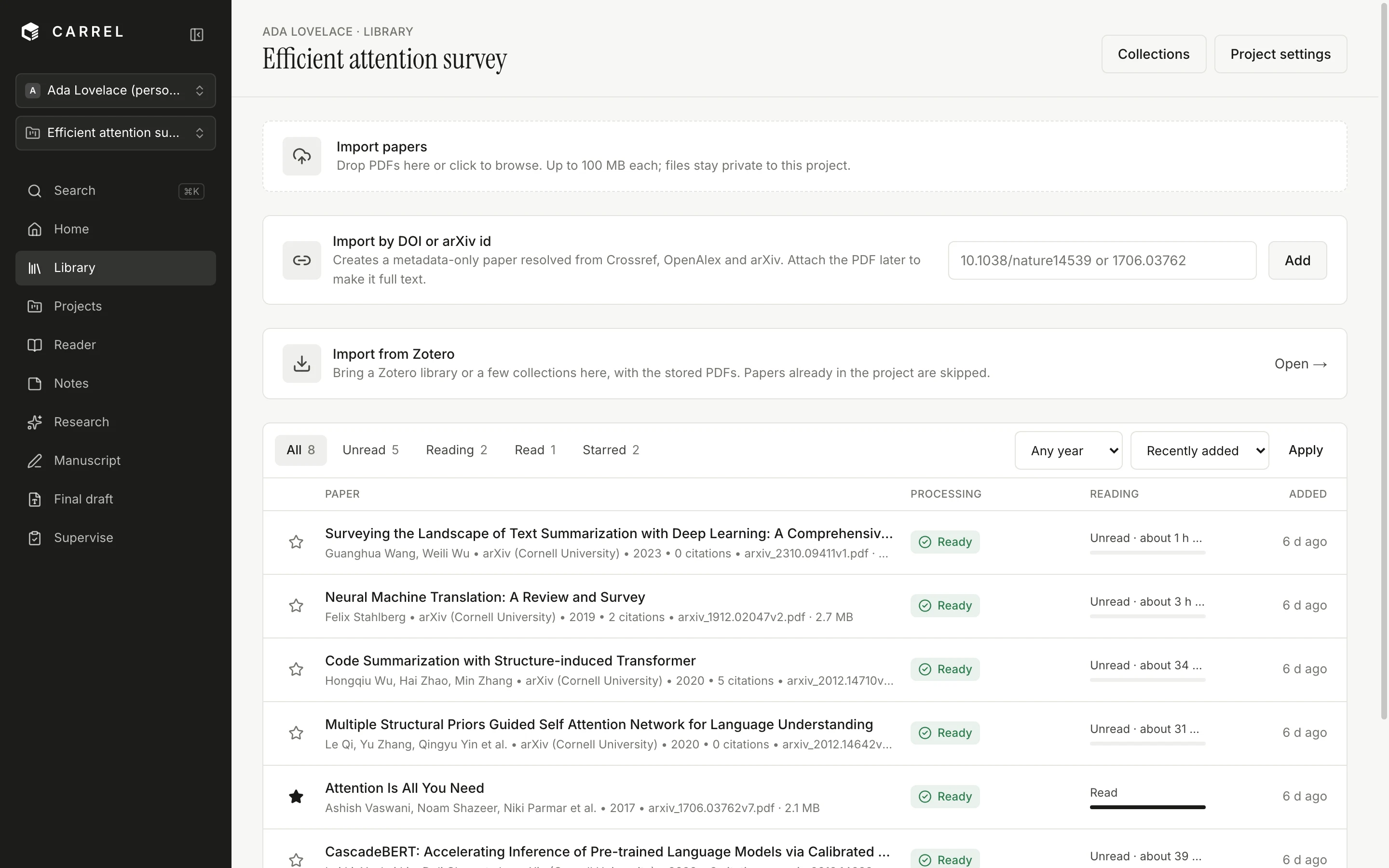
You can bring in the papers you already have from Zotero, PDF, DOI, or arXiv, read and annotate them, and ask questions against the papers in your own library. Answers link back to the passages they came from.
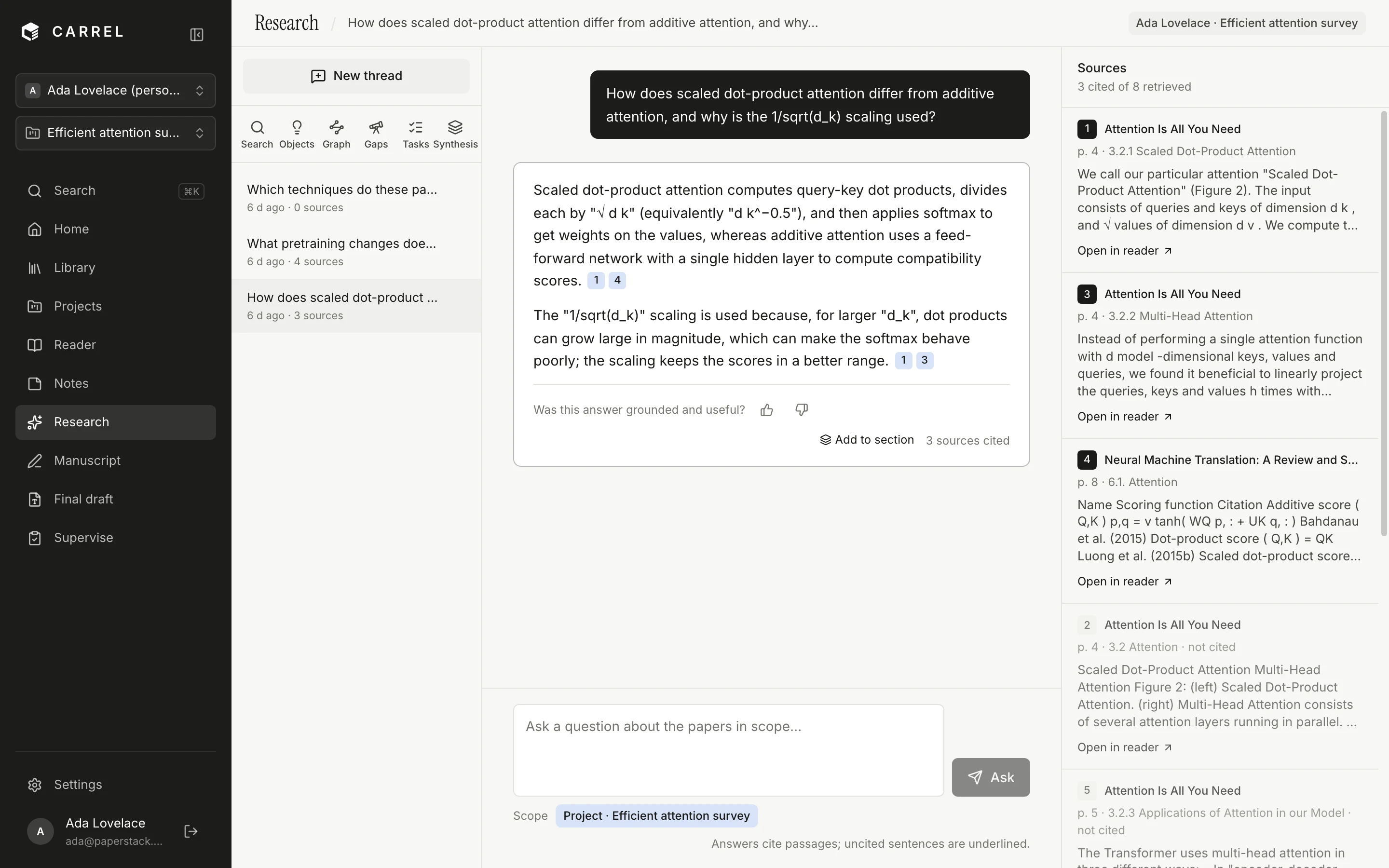
But the more important step comes after reading.
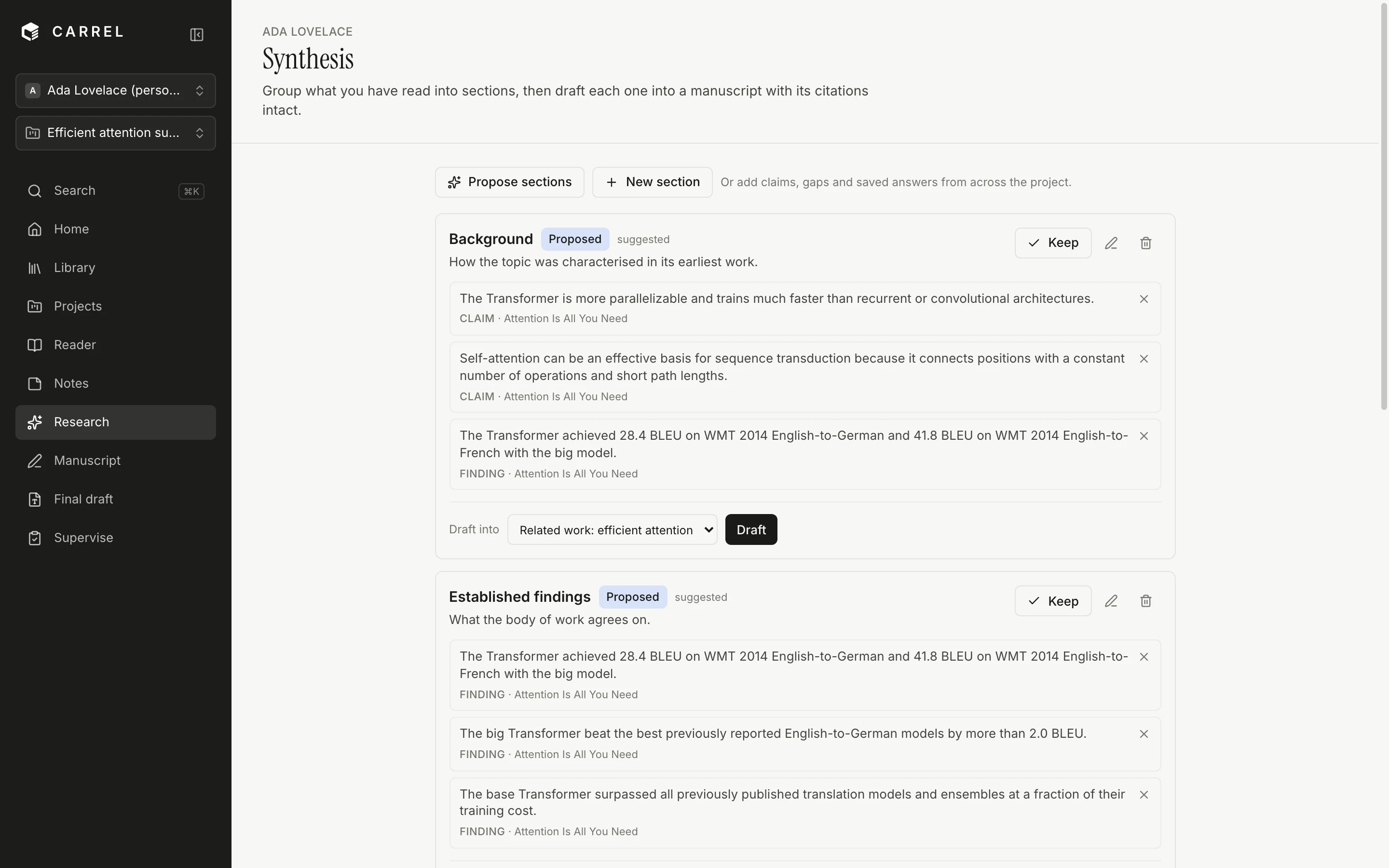
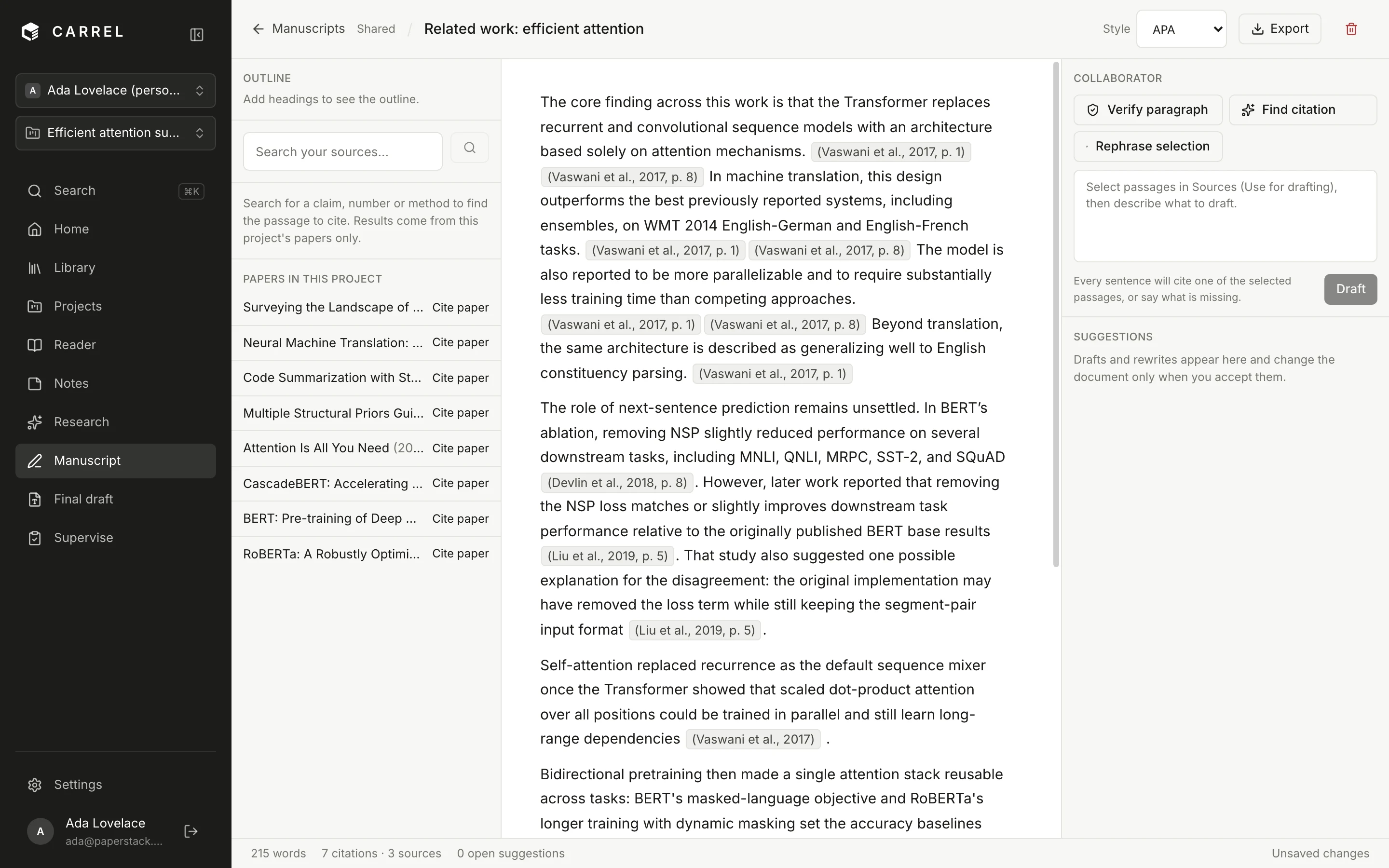
Carrel extracts claims, methods, and findings with their source passages attached, then helps surface where papers support one another, contradict one another, or leave a question unresolved. Those relationships can become starting sections for a manuscript.
That does not decide your argument for you.
It gives you a way to see the evidence you are already working with without holding the whole literature in your head.
If you are staring at a folder full of PDFs and do not know what to write first, the goal is not to make the machine write your thesis.
The goal is to make the next research decision visible.
How Carrel takes a literature review from the first import to a drafted section →
What to do next
Once you have a working set of papers, the next problem is usually synthesis.
You know what each paper says. Now you need to explain what they say together.
Read next: How to Synthesize a Literature Review Without Writing One Summary per Paper
If you already understand the literature but freeze when you open the draft, go to: Thesis Writer’s Block: What to Do When You’ve Read Everything but Still Can’t Write
Frequently asked questions
What is the first step in writing a literature review?
Start by defining a focused research question or problem. Use it to decide which literature is relevant and what you need to learn from each source. Searching without a working question often produces a large collection of papers without a clear way to organise them.
How many sources should a literature review have?
There is no single correct number. The appropriate number depends on your field, research question, degree level, document type, and the scope of the review. Aim to represent the major relevant research, important disagreements, and the evidence needed for the claims you make.
Should I finish reading before I start writing?
Usually not. Reading and writing work better as an iterative process. Drafting early helps expose missing evidence, weak connections, and questions that need further searching.
How should I take notes for a literature review?
Take notes around claims, questions, themes, methods, and relationships between papers — not only around individual paper summaries. Keep the exact source and passage attached to important evidence so you can verify it later.
Can AI write a literature review?
AI can assist with parts of the workflow, but the researcher still needs to choose the relevant literature, evaluate the evidence, interpret disagreements, decide what matters, and own the argument. Any AI-generated synthesis or prose should remain traceable to the underlying sources and be checked against them.
Sources and further reading
- Purdue OWL, Writing a Literature Review
- Purdue OWL, Symptoms and Cures for Writer’s Block
- Scribbr, How to Write a Literature Review
- Harvard Library, Literature Reviews and Research Guides
- r/PhD, How to start the lit review
- r/research, Literature review — best way to write and synthesize?
The Reddit discussions above are used as qualitative examples of common researcher frustrations, not as representative survey data.
Written by The Carrel team. Published 24 September 2026.